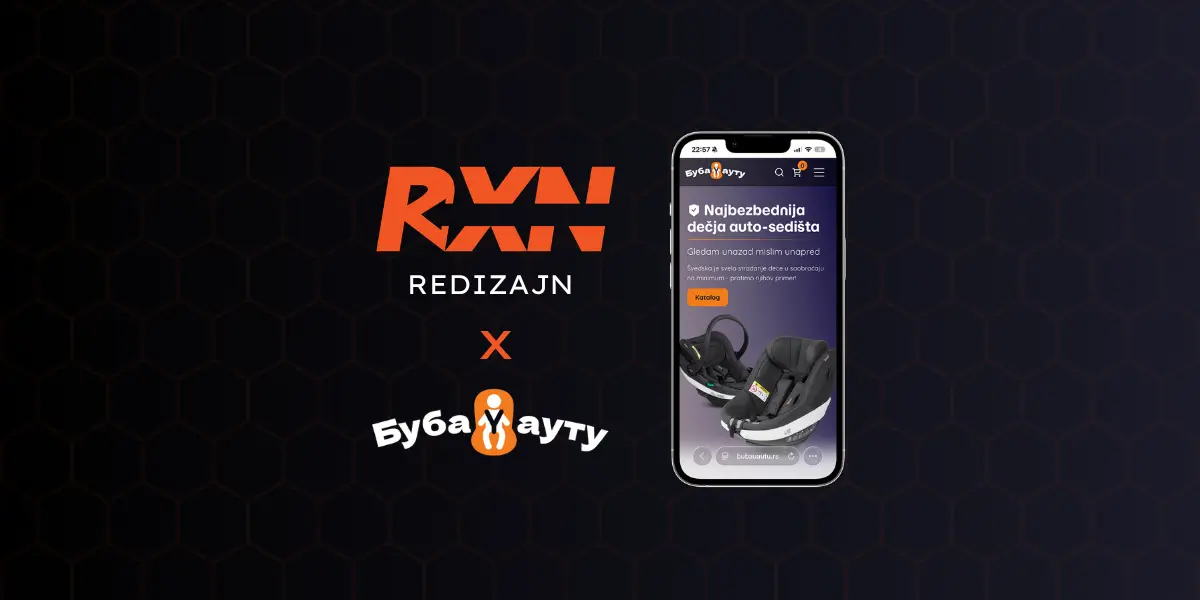
Case Study: Redesigning a Successful WooCommerce Store
How to design a store that is already doing well — Migration from Elementor to custom solution, scheduling system consultation, Core Web Vitals from Failed to Passed and 33% more clicks from Google Search.
Industrija
E-commerce — Safety equipment for children in traffic
Obim rada
WooCommerce store redesign, migration from Elementor to ACF and custom templates, scheduling consulting system, custom search and filters, custom checkout, performance optimization
Outcome
Core Web Vitals from Failed to Passed (CrUX), +33% clicks and +25% views in Google Search, average position from 8.1 to 5.1
Most redesigns start from problems. The website is broken, fails to generate enquiries, or looks outdated — and needs to be fixed.
This one went a different way.
Bug in the Car is a children’s car seat store that was already successful when they contacted us. The site was created by the owners themselves, in Elementor, with tutorials and without technical knowledge. And with it they built a serious business, a recognizable name and five stars on Google.
The question wasn’t how to fix a site that didn’t work. The question was how to make a site corresponding to the level of service they were already providing.
Context: Why this business is specific
In order to understand the decisions we have made in design, we first need to understand what the Beetle in the Car actually does.
Led by Jelena Bilić, a child car seat consultant at the Parent Association, with BeSafe Premium Partner Academy certificate and many years of experience.
Their work does not end with the sale. They offer free live seat assembly, parent training for self-assembly and continuous support after purchase. They have installed more than 300 seats on a voluntary basis — and in 90% of cases found faulty assembly.
It’s a business where you don’t sell a product, you sell a child’s safety, and a product is just an asset.
And that was the key to the redesign.
Brief: what the client was looking for
The demands were clear:
Refresh the look of the site
Rewrite functionality that made it difficult for customers to purchase
Look professional on the web, according to the way they work live
The last item was the most important. There was a gap — The live service was patient, dedicated, and expert, and the site did not transmit this.
Access: Security before catalog
The usual approach to e-commerce redesign is to subordinate everything to sales — highlight products, actions, discounts, “Buy” button at every step.
That would be wrong here.
A parent choosing a car seat may not know what to look for. They may not understand the differences between seat groups, what i-Size means, why rear-facing travel is safer, or how easily a seat can be installed incorrectly.
A website that pushes products before explaining the choice does not help — it creates confusion.
So we redesigned around a simple principle: The website should explain first and sell second. The structure, navigation and visual language are designed to help parents understand what they are choosing and why — not just see a price.
The solutions that came from this
The system of appointment consultation
The largest functional novelty. The choice of a car seat depends on three variables — child, car and budget. It is not solved by a filter.
We have implemented a system of arrival and consultation scheduling, which allows the parent to book an appointment, come with a car and find a solution that fits the specific situation with Jelena.
This is not a functionality found in the WooCommerce e-commerce add-ons catalog. It is a functionality that comes from understanding how this business really works — What we have written about in the text Difference Between Site and System.
Product-friendly search and filters
Instead of the standard WooCommerce search, we developed a custom search solution and filters on catalog pages — adapted to the way the parent actually chooses, including filtering by the height of the child.
Redesigned product page
The product page received special treatment: a more transparent display of attributes and colors, a clearer hierarchy of information, and trust signals in places where the customer makes a decision.
Custom checkout
The payment process has been modified with additional checks and functionalities tailored to their way of doing business — Instead of the standard WooCommerce checkout that is generic for each store.
Brands as a separate category
Previously, brands were not explicitly available in navigation. We added them as a separate path, because part of the customers come already knowing which brand they are looking for.
Technical side: from Elementor to full control
The site was built in Elementor. It was a logical choice for someone who makes the site himself, but for further growth it represented a limitation — in speed, in flexibility and in control of code.
What is done
Migration from Elementor to ACF and custom templates. Content is still edited through simple fields in WordPress administration, but the output code is generated from our templates — without layers that the page builder adds.
Removed about ten additions. Mostly analytical tools that were duplicated, and add-ons that added UI or functionality to WooCommerce — everything that is replaced by its own solutions.
Cleared database. Removed the remnants of deactivated add-ons and accumulated data that slowed down the site.
Cloudflare. The site is connected to Cloudflare for faster content serving and an extra layer of security.
Custom Mobile Access Administration. Owners spend most of the day working with customers. Access to WordPress administration is optimized so that basic changes can be made from the phone, between two terms.
How long it took
The migration continued. two months. The store was working normally all the time — the work took place on a copy of the site, and the transition to the new version was carried out in one move.
Results
Core Web Vitals
The Core Web Vitals assessment improved from Failed to Passed, with a substantial performance gain — especially on mobile devices.
Important note: this is CrUX data, i.e. a measurement based on real user visits, not a laboratory test. This is a stricter and more realistic measure. Why the speed of the site today is mandatory and not optional, we explained in the text about Signs that the site needs a refresher.
Visibility in Google Search
Metrics
March–August 2025.
February–July 2026.
Change
Displays
~120.000
~150.000
+25%
Clicks
~15.000
~20.000
+33%
The average position
8,1
5,1
3 places better
Click growth is faster than display growth — which means that the site not only appears more often, but people choose it more often when they see it.
Sales
Accuracy is required here, as the figures can easily be displayed in a better light than they are.
By comparing the same calendar period one year later — February–July 2025 compared to February–July 2026. — The number of orders increased by About 18%.
We deliberately compare the same period of the year, because the sale of car seats has a pronounced seasonality. However, that growth cannot be attributed to the website alone.
What the site didn’t do
A growth of 18% is a good result, but it would be incorrect to attribute it exclusively to the redesign.
In the same period, brands were introduced as a separate category, which probably brought some traffic. — through recommendations, presence on social networks and a reputation built by years of work.
What the redesign did was remove obstacles. Faster site, clearer navigation, simpler shopping process and better search position mean fewer people give up along the way. How much of that 18% falls on it — it is impossible to measure accurately, and we would not argue the opposite. About why the guarantees of results in this branch of red flags we wrote in a special text.
The Client’s Word
Perfect cooperation, even better service and the best design, transparency and functionality of the site that RXN Web Solutions has done for us. After redesigning and adding new features, it is much, much easier for our customers to navigate and choose the desired item. 10 out of 5 stars from Beetles in the car!
Bug in the Car
What We Learned From This Project
The site the owner made himself is not a failure. Opposite — The Bug in the Car built a serious business with such a site. The redesign was not a correction of a mistake, but the next step.
The best functionality does not come from the solution catalog. The consultation scheduling system is not a standard e-commerce function. It was created from understanding how this business works live.
The design should reflect the way it works, not the trends. The decision to put safety first instead of products comes directly from how Jelena works with parents — patiently, educationally, without pressure.
Measurement must be fair to be useful. Without comparing equivalent periods, the figures help neither the client nor us.
Frequently Asked Questions
How long does it take to redesign a WooCommerce store?
It depends on the scope. This project — with migration from page builder, custom functionality and scheduling system — it took two months. A simpler visual redesign of a smaller store can be done in a few weeks. Read more What the redesign entails and how much it costs We wrote in a special guide.
Does the store stop working during the redesign?
No. Work is done on a copy of the site, while the existing store normally receives orders. Switching to the new version is done in one go, with a short break.
Why switch from Elementor to custom solution?
Page builders are great for fast start and independent work, but they add layers of code that slow down the site and limit control. For a growing store, switching to custom templates brings better speed and full flexibility.
Does the redesign guarantee sales growth?
No, and anyone who claims that is not telling the truth. — Faster website, clearer navigation, easier shopping. How much this will affect sales also depends on products, prices, competition and marketing.
What are Core Web Vitals and why are they important?
These are the three Google metrics that measure a real user experience — Loading speed, responsiveness and visual stability. Google uses them as a ranking factor, and they directly affect how many visitors stay on the site.
Conclusion
Redesigning the Bug in the Store Car was not a fix for what wasn’t working. It was aligning the site with the level of service the client was already providing live.
The result is a store that loads faster, ranks better in search, explains more clearly why the choice of car seat is important — and gives the owners the tools to run it themselves.
Collaboration continued through monthly maintenance — about what this work specifically covers we have written in a related case study.
Do you have a WooCommerce store that’s time to upgrade? Contact us — We’ll be happy to review it, with no obligation.
RXN
RXN Web Solutions
WordPress agencija iz Stare Pazove sa 10+ years of experience u izradi web sajtova.
Your cookie choices
We use essential cookies to make the website work. With your permission, we may also use optional cookies for preferences, analytics, and marketing. You can accept, reject, or change your choice at any time.